You find a trusted supplier overseas offering genuine branded stock at a price you cannot ignore. The paperwork checks out, the products are real, and parallel import feels like a smart way to compete on Amazon.
Then a rights owner complaint lands, an “inauthentic” flag appears, or your listing is suddenly suspended.
From your perspective, you did everything right. From Amazon’s perspective, foreign warranties, different labels, or non-US packaging are warning signs. Understanding that gap is the first step to protecting your account when you deal with parallel imports.
Parallel Imports on Amazon and the Hidden Compliance Risks
Parallel imports, also called grey market goods, are genuine products purchased abroad and resold in the U.S. without the brand owner’s direct permission. While U.S. trademark law generally allows for this under the exhaustion doctrine, Amazon doesn’t simply follow legal precedent. Its risk protocols are stricter, focusing on protecting buyer trust through clear provenance and transparency into authorized sources.
Here’s where the friction starts: even when a product is authentic, it may arrive with foreign warranties, different labeling, or packaging designed for another region.
As far as Amazon is concerned, those differences erode buyer confidence and make it harder to verify authenticity at scale. Any detectable mismatch in packaging, serial numbers, or missing U.S. market identifiers can trigger an “inauthentic” finding.
For a free legal consultation, call 888-600-1925
The Legal Framework: First Sale, Exhaustion and “Material Differences”
When you resell branded products, you rely on the first-sale doctrine. In simple terms, once a brand owner sells a genuine product, their trademark rights in that specific item are “exhausted,” and you’re generally allowed to resell it. But that’s not the whole story for parallel imports.
Different regions follow different exhaustion models, national, regional, or international, and that affects whether importing genuine goods from another market is lawful where you sell.
In the U.S., courts look closely at “material differences” between your imported product and the version authorized for your marketplace. Changes in formulation, quality control, packaging, instructions, safety warnings, or warranty and support can all count.
For you as a seller, the key point is this: even if your parallel imports are materially identical to the locally authorized version, you can still face IP claims.
How Amazon Treats Parallel Imports In Practice?
When you list on Amazon, you are expected to follow local laws and respect IP rights. It does not treat a product as “safe” just because it’s genuine.
You’ll usually see issues show up in a few ways:
- Inauthentic or counterfeit complaints when your product doesn’t match the branded listing or what customers receive from authorized sellers.
- “Not as described” or “used sold as new” complaints when packaging, manuals, plugs, or language differ from what buyers expect in the local version.
- Trademark or copyright complaints when rights owners argue there are material differences or that you’re not part of their authorized distribution network.
If that happens, you risk ASIN deactivation, account suspension, held funds, and in some cases, legal action outside Amazon.
Click to contact our amazon law lawyers today
Risk-Control Checklist Before You List Parallel Imports
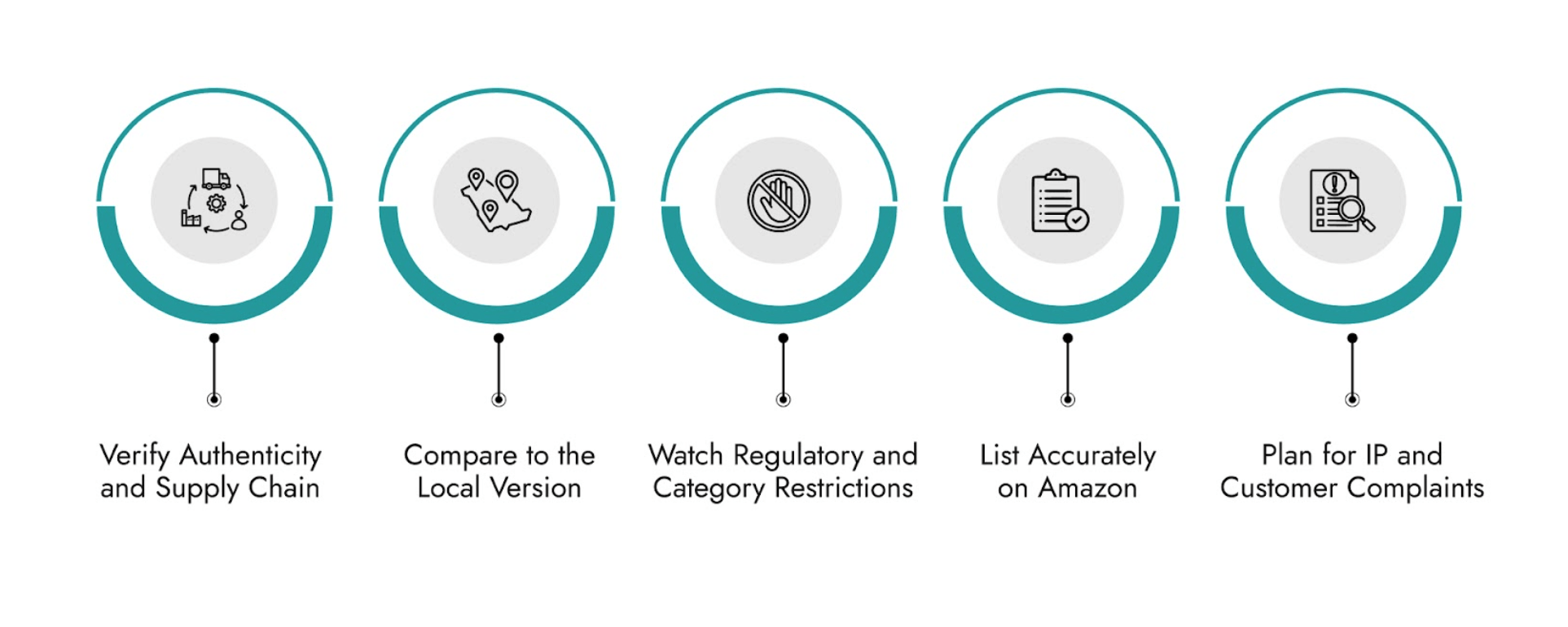
1. Verify Authenticity and Supply Chain
Source only from reputable wholesalers; keep invoices, contracts, and correspondence proving authenticity and chain of title.
2. Compare to the Local Version
Check SKU/model, technical specs, labeling language, safety marks, and user manuals against the version commonly sold in your target country. Flag any change in ingredients, voltage, plug type, region locks, or warranty terms.
3. Watch Regulatory and Category Restrictions
Be cautious with categories like cosmetics, medical devices, supplements, electronics, children’s products, and food, where local compliance and labeling rules are strict.
4. List Accurately on Amazon
Do not drop foreign-market goods onto an ASIN created for a different version. Avoid implying you are an “authorized” seller or that manufacturer warranties apply if they do not.
5. Plan for IP and Customer Complaints
Have a process and documentation ready in case a brand owner or Amazon questions your inventory.
Complete a Free Case Evaluation form now
When Parallel Imports Require Professional Legal Support
Situations where professional help is critical:
- You plan to build a business model around parallel imports and need a risk assessment and strategy.
- You have received IP complaints, a rights-owner notice, or “inauthentic” / “not as described” flags related to imported merchandise.
- Your ASIN or account has been suspended over suspected gray-market goods, or funds are being held.
- Your products are flagged across multiple international markets.
- Your appeals keep triggering vague or contradictory responses from Amazon.
- You need to coordinate documentation with upstream suppliers who aren’t familiar with Amazon’s compliance standards.
Get Legal Support for Your Amazon Seller Accounts

Managing Amazon seller accounts can accelerate your growth, but it also puts you under Amazon’s strict compliance lens. You need a clear, evidence-backed explanation that shows your accounts are legitimate, compliant, and independently operated.
At ESQGo, we work with complex multi-account structures every day. We understand how Amazon links accounts, reviews, and supporting documents, and how it evaluates genuine business needs versus policy violations. At ESQgo, our team of attorneys:
- Analyze how your accounts are set up and how they are interconnected.
- Identify risk areas that could trigger related-account flags.
- Prepare structured, legal submissions that help Amazon view your accounts as separate businesses.
Evaluate risks, correct structural gaps, and build a compliance strategy aligned with Amazon’s multi-account expectations.
Get legal support for your Amazon seller accounts today.
Call or text 888-600-1925 or complete a Free Case Evaluation form