| TL;DR Brand protection often fails when businesses focus only on legal rights and ignore marketplace controls.Unauthorized sellers, counterfeit inventory, and listing abuse usually stem from operational weaknesses rather than trademark ownership issues.Effective marketplace brand enforcement combines monitoring, seller governance, evidence collection, and escalation workflows.Brands that rely solely on reactive takedowns often face recurring violations and revenue leakage.A strong marketplace strategy helps protect pricing integrity, Buy Box ownership, and customer trust. |
Many brands invest heavily in trademarks, intellectual property protection, and takedown requests. Yet unauthorized sellers continue appearing on listings, counterfeit products keep resurfacing, and pricing instability creates ongoing channel conflict.
The reality is that brand protection often fails because brands focus on legal ownership while overlooking control in the marketplace.
Marketplace abuse has become increasingly sophisticated and global in scale. Amazon reported that its Counterfeit Crimes Unit pursued more than 32,000 bad actors across 14 countries in 2025, highlighting how persistent online infringement remains despite advances in enforcement technology and platform protections.
Modern brand protection requires a marketplace strategy built around visibility, seller control, evidence collection, and consistent enforcement. Without those elements, even strong intellectual property rights may do little to prevent recurring abuse.
What Causes Brand Protection Efforts To Fail?
Many brands assume enforcement begins when a violation appears. In reality, most enforcement failures begin long before the first counterfeit complaint, pricing issue, or unauthorized seller is discovered. Several common gaps weaken brand protection efforts:
- Limited marketplace visibility
- Weak reseller oversight
- Poor inventory controls
- Inconsistent enforcement procedures
- Lack of monitoring systems
- Delayed response times
When brands treat violations as isolated incidents, they often focus on removing individual sellers instead of addressing the root cause.
A counterfeit seller removed today may return tomorrow under a different storefront. A listing hijacker removed this week may reappear on another ASIN next month. Without a marketplace strategy, enforcement becomes a cycle of reacting rather than preventing.
For a free legal consultation, call 888-600-1925
Why Legal Protection Alone Cannot Stop Marketplace Abuse
Trademarks, copyrights, and intellectual property rights are important foundations for brand protection. They establish ownership and provide legal standing when violations occur.
However, legal ownership does not automatically stop marketplace abuse. Unauthorized sellers can continue selling legitimate inventory. Counterfeit operators can launch new storefronts. Listing manipulators can alter product pages before brands notice.
Even Amazon’s own systems recognize this challenge. The company reports proactively blocking more than 99% of suspected infringing listings before brands ever report them.
Yet marketplace abuse still exists.
That is because many marketplace problems involve operational issues rather than direct intellectual property violations. Inventory diversion, reseller leakage, Buy Box manipulation, and pricing abuse often require different enforcement approaches.
Strong marketplace brand enforcement combines legal rights with marketplace monitoring, seller oversight, and structured escalation processes.
How Unauthorized Sellers Undermine Brand Protection
Unauthorized sellers remain one of the most common threats facing marketplace brands. These sellers may acquire products through:
- Distribution leaks
- Excess inventory sales
- Liquidation channels
- Gray-market sourcing
- Unauthorized reseller networks
Once unauthorized sellers appear on listings, pricing pressure often follows. Many times, unauthorized sellers advertise products below a brand’s Minimum Advertised Price (MAP). The impact extends beyond pricing alone. Unauthorized sellers can:
- Create Buy Box instability
- Damage reseller relationships
- Reduce profit margins
- Cause customer confusion
- Increase support and return issues
Many brands mistakenly view unauthorized sellers as a legal problem when the issue often originates in distribution and inventory management.
Marketplace brand enforcement begins with controlling who has access to inventory and who is allowed to represent the brand online.
Click to contact our amazon law lawyers today
Why Monitoring Is the Foundation of Marketplace Brand Enforcement
You cannot enforce what you cannot see. Many brands discover violations only after revenue declines, customer complaints increase, or pricing issues become widespread.
By that point, the damage may already be significant. Effective marketplace brand enforcement relies on continuous monitoring of:
- Seller activity
- Buy Box ownership
- Pricing changes
- Listing edits
- Review patterns
- Storefront behavior
Monitoring also helps brands identify repeat offenders and emerging threats before they spread across multiple listings.
Without visibility, enforcement efforts become reactive. With visibility, brands can identify issues early and respond before they affect revenue performance.
Complete a Free Case Evaluation form now
How Listing Abuse and Counterfeit Activity Spread across Marketplaces
Marketplace abuse rarely remains isolated to a single listing.
Unauthorized changes to titles, images, product descriptions, or variations can affect customer trust and listing performance. Counterfeit inventory can create negative reviews that remain visible long after the fake products are removed.
The challenge continues to grow across online marketplaces. Research found that 9% of authenticated products in 2023 were identified as counterfeit. Counterfeit activity creates several problems:
- Review damage
- Increased refunds
- Customer trust concerns
- Listing suppression risks
- Revenue loss
Listing abuse creates similar challenges.
Incorrect variations, altered product content, and unauthorized edits can weaken listing accuracy and create confusion among customers.
Without a marketplace strategy, these issues often spread across multiple ASINs before brands recognize the extent of the problem.
Components of a Strong Marketplace Brand Enforcement Strategy
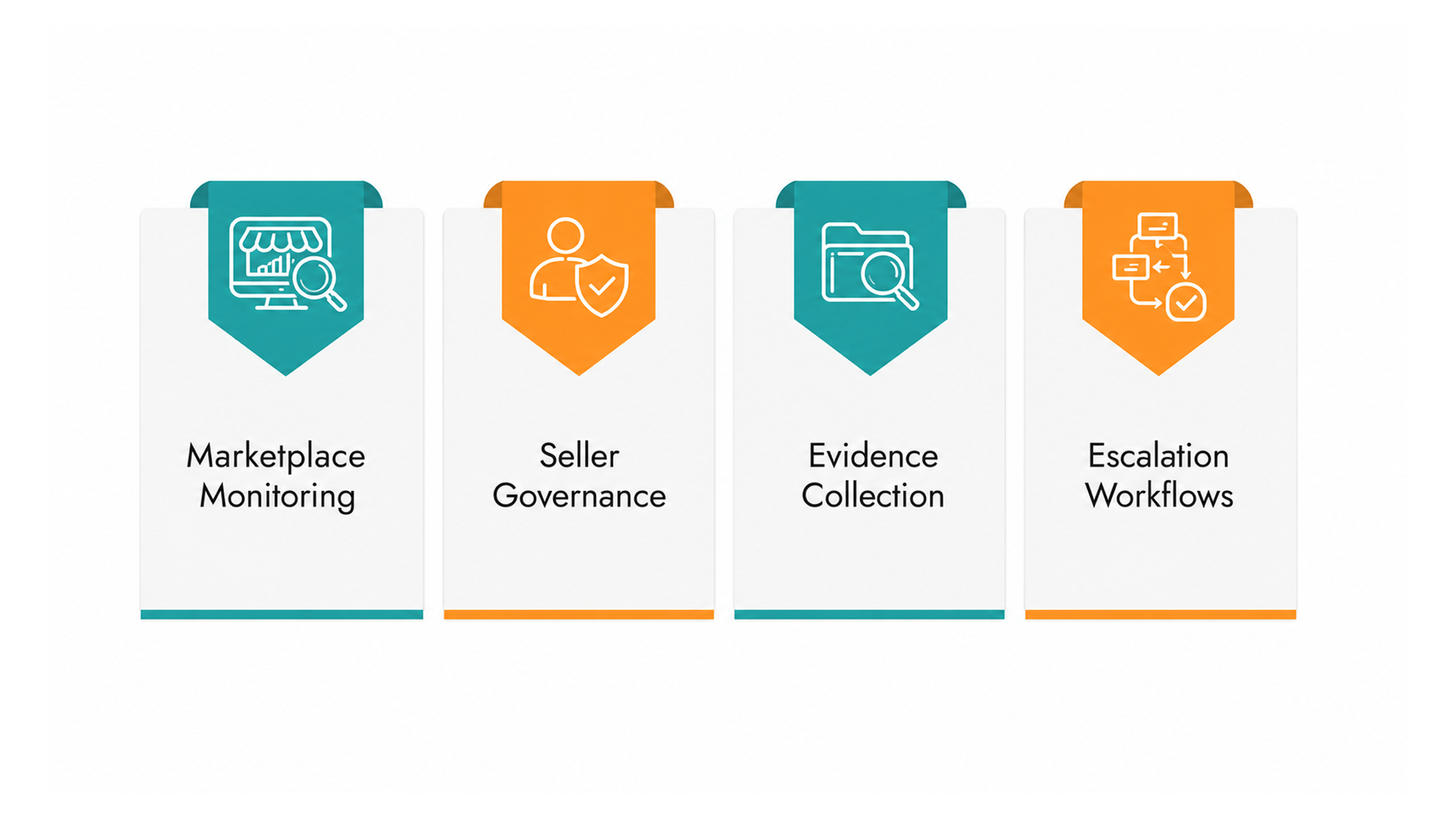
Successful marketplace brand enforcement requires multiple layers working together.
Marketplace Monitoring
Monitoring provides the visibility needed to detect abuse early. Brands should regularly track:
- Seller counts
- Pricing activity
- Buy Box changes
- Listing edits
- Customer feedback
Consistent monitoring helps identify threats before they become larger marketplace problems.
Seller Governance
Strong seller governance creates control over distribution and reseller activity. Brands should establish:
- Authorized reseller policies
- Distribution controls
- Inventory tracking procedures
- Clear marketplace guidelines
Without governance, unauthorized inventory often continues reaching marketplaces even after enforcement actions remove individual sellers.
Evidence Collection
Enforcement depends on documentation. Brands should maintain organized records that include:
- Screenshots
- Product images
- Test buys
- Invoices
- Seller histories
- Pricing records
Proper documentation improves enforcement success and helps support escalation efforts.
Escalation Workflows
Not every violation requires the same response. Brands should create clear escalation procedures that define:
- Counterfeit enforcement paths
- Unauthorized seller responses
- Legal review triggers
- Repeat offender handling
Structured workflows reduce delays and improve consistency across enforcement efforts.
What Effective Marketplace Brand Enforcement Looks Like
Effective marketplace brand enforcement is proactive rather than reactive. Strong enforcement programs focus on:
- Early detection
- Fast evidence collection
- Consistent escalation
- Ongoing monitoring
The goal is not simply to remove individual violations. The goal is to reduce repeat abuse and maintain marketplace control over time.
Response speed also matters. During that period, pricing pressure, customer confusion, and revenue loss can continue growing.
Brands with structured enforcement systems can identify violations faster and respond more effectively.
How BELU™ Helps Brands Strengthen Marketplace Control
Many enforcement programs focus almost exclusively on takedowns. BELU™ takes a broader approach. Instead of treating marketplace abuse as isolated violations, BELU™ focuses on strengthening marketplace control through:
- Marketplace visibility
- Seller governance
- Evidence-backed enforcement
- Escalation workflows
- Revenue protection strategies
This approach helps brands address the underlying causes of marketplace abuse rather than repeatedly responding to the same violations.
Marketplace brand enforcement works best when legal strategy, operational controls, and marketplace intelligence work together.
Protect Your Marketplace Revenue with BELU™ Brand Enforcement

Marketplace abuse rarely stays contained. Unauthorized sellers, counterfeit inventory, listing manipulation, and pricing instability can gradually weaken revenue performance and marketplace control.
At ESQgoⓇ, our attorneys:
- Analyze marketplace risks and seller activity across your catalog.
- Identify unauthorized sellers, counterfeit exposure, and revenue risks.
- Build evidence-backed enforcement systems with monitoring and escalation workflows.
- Strengthen long-term marketplace control through BELU™ Brand Enforcement.
Protect Your Brand Today with our Brand Enforcement Report.
FAQs
What is marketplace brand enforcement?
Marketplace brand enforcement is the process of identifying, addressing, and preventing unauthorized seller activity, counterfeit products, listing abuse, and other violations that affect marketplace performance.
Why does brand protection fail on Amazon?
Brand protection often fails when businesses focus solely on legal rights and reactive takedowns instead of implementing monitoring systems, seller governance, and marketplace controls.
How do unauthorized sellers affect brand protection?
Unauthorized sellers can create pricing instability, Buy Box disruption, customer confusion, and channel conflict that weaken marketplace performance and brand reputation.
What is the difference between brand protection and marketplace brand enforcement?
Brand protection refers to the overall strategy used to safeguard a brand. Marketplace brand enforcement focuses specifically on detecting violations, collecting evidence, and taking action against marketplace abuse.
Why is marketplace monitoring important for brand enforcement?
Monitoring helps brands detect unauthorized sellers, pricing issues, listing changes, and counterfeit activity before those problems create significant operational or revenue impacts.
Call or text 888-600-1925 or complete a Free Case Evaluation form