Executive Summary: A counterfeit without a test buy complaint on Amazon usually means a rights owner has told Amazon that your item is not authentic, even though no sample purchase was made first.Amazon treats counterfeit policy issues seriously. Inauthentic product findings may result in listing removal, account suspension, inventory disposal, or withheld funds.In many cases, sellers are asked to support authenticity with supplier invoices, a letter of authorization, or a rights owner retraction.A careful review of sourcing, listing content, and appeal evidence usually gives sellers the strongest path forward.
If you sell on Amazon, a counterfeit complaint is one of the most serious policy issues you can face, and the notice becomes especially confusing when it says counterfeit without a test buy. Many sellers assume this means Amazon confirmed the item was fake, but that is not usually the case. In most situations, the complaint begins with a rights owner’s report, and Amazon may record a policy violation before purchasing a sample from your Amazon listing.
In this blog, you will learn what such counterfeit complaints really mean, why they happen, and the exact steps to take to defend your metrics, prove authenticity, submit a strong Plan of Action, and protect your store.
What Does Counterfeit Without A Test Buy On Amazon Mean?
A counterfeit without a test buy complaint usually appears under policy compliance or account health after a rights owner reports that a listed item is not authentic. Amazon forum guidance describes it as a situation in which a rights owner asserts that the item in question is inauthentic, and sellers are directed to submit an appeal through the Account Health path.
In plain terms, the complaint is about authenticity, not just listing language. Amazon is not saying it bought and lab-tested the item; it is saying a rights owner raised an authenticity claim and expects the seller to respond with proof. This distinction is crucial because many sellers lose time arguing over the lack of a test buy instead of addressing the real issue. The stronger response is document-backed evidence showing a legitimate product source, such as invoices, letters of authorization, licensing records, or a rights owner retraction.
For a free legal consultation, call 888-600-1925
Why Does Amazon Take Counterfeit Complaints Seriously?
Amazon’s anti-counterfeiting policy states that selling or supplying inauthentic goods may result in the immediate suspension or termination of the selling account and any related accounts. Amazon also states that it may dispose of inauthentic goods at fulfillment centers at the seller’s expense and withhold payments when it learns that an account was used to sell inauthentic products or engage in fraud.
The above situation explains why a counterfeit complaint often feels much heavier than other policy notices. Even when a seller believes the complaint is wrong, Amazon’s priority is customer trust and marketplace safety. Amazon has also said it removes suspicious listings based on its own product reviews and works with rights owners and law enforcement to hold sellers who knowingly violate the policy accountable.
Why Do Amazon Sellers Receive The Rights Owner Complaint?
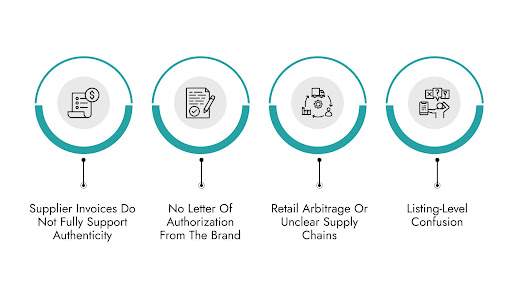
A counterfeit complaint does not always mean a seller knowingly listed fake goods. In many cases, the issue begins with sourcing gaps or poor documentation rather than deliberate fraud. Some of the common reasons for Amazon Rights owner complaints against sellers include:
Click to contact our amazon law lawyers today
Supplier Invoices Do Not Fully Support Authenticity
One common issue is weak paperwork. Amazon forum guidance states that sellers appealing this type of complaint are often expected to submit invoices that prove authenticity. If the invoice does not clearly connect the goods to a reliable source, it may not resolve the complaint.
Complete a Free Case Evaluation form now
No Letter Of Authorization From The Brand
Amazon guidance also points sellers toward the letter of authorization Amazon documentation path. Forum responses indicate that sellers may submit a letter of authorization or a licensing agreement to verify authenticity and obtain permission to sell branded goods.
Retail Arbitrage Or Unclear Supply Chains
Amazon’s supplier due diligence guidance tells sellers to confirm whether a supplier is an authorized or certified distributor, reseller, or partner of the brand. It also tells sellers to check whether the supplier can provide a letter of authorization or invoices from its own supplier to verify product provenance.
That guidance shows where many sellers run into trouble. If your source is several steps removed from the brand, proving authenticity becomes much harder.
Listing-Level Confusion
Some complaints begin when a seller lists against the wrong ASIN, uses incorrect branding, or offers inventory that differs from what the detail page describes. Rights owners often monitor listings closely and report abuse through Amazon’s reporting tools. Amazon’s public guidance for rights owners discusses removing suspected counterfeit products and reporting abuse tied to inaccurate product listings.
What To Do After A Counterfeit Without A Test Buy Appeal Notice?
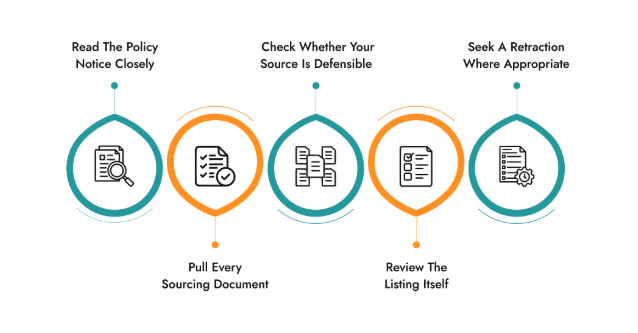
If you receive a counterfeit without a test buy complaint on Amazon, gather proper documentation and follow the steps below:
1. Read The Policy Notice Closely
Amazon forum guidance tells sellers to go to Seller Central > Performance > Account Health > Policy Compliance > Counterfeit without a test buy > Submit appeal. The notice itself usually points to the complaint path and may include rights-owner details or instructions relevant to a retraction or dispute.
2. Pull Every Sourcing Document
Gather invoices, supplier details, brand communications, purchase records, and any licensing or authorization documents; Amazon forum responses repeatedly direct sellers to invoices and letters of authorization as core evidence of appeal.
3. Check Whether Your Source Is Defensible
Review where the goods came from and whether the supplier has a real brand connection. Amazon’s due diligence guidance tells sellers to verify supplier-brand affiliations and provenance records.
4. Review The Listing Itself
Confirm that the ASIN, brand, packaging, images, and variation structure all match the item you sourced. If the complaint stemmed from a listing mismatch, fixing the detail page issue may support your broader response. Amazon’s guidance for rights owners shows that counterfeit concerns and inaccurate product listing issues are often linked.
5. Seek A Retraction Where Appropriate
Amazon forum guidance states that if a seller is unable to provide an invoice or a letter of authorization, the seller must work with the rights owner to acquire a retraction. That often becomes the strongest option when the seller has genuine stock but weak historical records.
Consequences Of Ignoring A Brand Dispute
Doing nothing after receiving a counterfeit complaint poses a significant financial risk to your e-commerce business. The notice itself is a formal warning that your account is under strict scrutiny.
- Immediate ASIN Suppression: Amazon removes your listing the moment the rights owner submits the form. You lose your ranking and daily sales velocity instantly.
- Frozen Account Funds: Amazon freezes funds in your seller account when it suspects fraudulent activity. You lose access to the cash flow needed to pay suppliers and run your operations.
- Total Account Deactivation: Your Account Health Rating drops significantly with every unresolved complaint. Once the rating falls into the danger zone, Amazon revokes your selling privileges entirely under Section 3 of their terms of service.
- Inventory Confiscation and Destruction: For sellers using Fulfillment by Amazon (FBA), your stranded stock remains locked in the warehouse. If you fail to successfully appeal the claim, Amazon eventually destroys the inventory, costing you thousands of dollars.
Resolve False Counterfeit Claims With Proper Legal Guidance
Appealing a counterfeit complaint often demands deep policy knowledge, especially when a brand ignores your emails or Amazon rejects your initial Plan of Action.
ESQgo®’s experienced Amazon seller attorneys handle false authenticity claims daily and understand how Amazon reviews documents and appeals. Their team analyzes the complaint, identifies suspension risks, communicates with brand counsel, and prepares a structured, legally sound appeal to help protect your listings and account health.
Get legal support for your Amazon seller accounts today.
Call or text 888-600-1925 or complete a Free Case Evaluation form