Many Amazon sellers consider opening multiple seller accounts to separate product categories, manage private-label brands, or reduce operational risk. It’s a common strategy, and in some cases, a legitimate one.
But Amazon treats multi-account activity as a high-risk compliance area. Even if you’re not doing anything wrong, the platform can restrict or suspend all connected accounts the moment it detects shared operations, overlapping data, or signals that suggest control by the same person or business.
Most issues arise not because sellers intentionally violate Amazon’s rules, but because they misunderstand how Amazon’s systems interpret links between accounts, whether through tax information, network activity, documents, suppliers, or login behavior.
In this blog, we take you through when you can legally have multiple Amazon seller accounts, what Amazon’s multiple seller accounts policy actually requires, how Amazon detects connections behind the scenes, and what you must do to stay compliant or recover quickly if a linkage suspension occurs.
What Amazon Really Allows With Multiple Seller Accounts
Amazon does not prohibit sellers from running multiple seller accounts. What it requires is a valid business reason, clear operational separation, and, ideally, Amazon’s approval before the second account goes live.
Without those elements, Amazon assumes the additional account may exist to get around enforcement actions, duplicate ASINs, or manipulate listings. That’s why Amazon’s multiple seller accounts policy is strict and heavily monitored.
For a free legal consultation, call 888-600-1925
Why Amazon Treats Multi-Account Setups As High-Risk
Running multiple accounts increases the chances of:
- Bypassing a suspension or listing restriction
- Manipulating catalog visibility or reviews
- Creating duplicate listings to influence the Buy Box
- Hiding compliance issues across different storefronts
To prevent this, Amazon evaluates not only your paperwork but your entire operational ecosystem. The platform checks for signs that two accounts might be controlled by the same person or share overlapping infrastructure.
How Amazon Detects Connections Between Seller Accounts
Amazon’s systems look far beyond tax IDs and business names. The platform flags connections through:
- Shared IP addresses or Wi-Fi networks
- The same devices or browser environments
- Common business documentation
- Invoices reflecting the same suppliers, formats, or fulfillment paths
- Overlapping legal entities, bank accounts, or contact information
- Metadata hidden in uploaded files (PDF fingerprints, image hashes)
When Amazon sees enough matching signals, it treats the accounts as linked accounts under the same controller, even if they’re registered under different legal entities.
Click to contact our amazon law lawyers today
What Sellers Need To Understand
You can operate multiple Amazon seller accounts, but only when each account has a justified purpose and a fully independent operational setup. Without that separation, all connected accounts are exposed to enforcement, and a single suspension can affect the entire network.
Complete a Free Case Evaluation form now
Why Sellers Misinterpret Amazon’s Multi-Account Rules
Even experienced sellers often misjudge what Amazon expects when it comes to running multiple seller accounts. Here’s where sellers commonly get it wrong and why these assumptions lead to suspensions.
- Believing a separate LLC automatically makes the account compliant
Many sellers think that creating a new LLC automatically approves a second Amazon account. However, Amazon cares more about who controls the account than the name on the paperwork. If both accounts share resources such as warehouses, suppliers, or devices, Amazon considers them to be operated by the same entity.
- Relying on different emails, addresses, or phone numbers for separation
While separate contact info helps, it’s not enough on its own. Amazon’s systems analyze technical signals such as IP addresses, device IDs, and login behavior. Using different emails but logging into both accounts from the same network can trigger a review.
- Assuming Amazon will only act if a rule is broken
A common misconception is that Amazon only investigates multiple accounts after performance issues, seller complaints, or listing violations occur. In reality, Amazon continuously monitors account activity in the background and proactively looks for patterns that suggest shared control. Sellers with perfect metrics can still be suspended if Amazon’s system flags their accounts as linked or suspicious.
- Submitting generic or template-based appeals during a suspension
Appeals that quote policies or provide high-level explanations won’t address Amazon’s concerns about account overlap. Detailed, evidence-backed explanations showing how accounts operate independently are necessary for reinstatement.
- Following unofficial advice or outdated guidance from peers
Seller forums and social media often offer outdated or oversimplified guidance. Amazon updates its detection and enforcement regularly, so advice from a year ago may no longer apply, potentially complicating reinstatement efforts.
How Amazon Actually Evaluates Multi-Account Activity
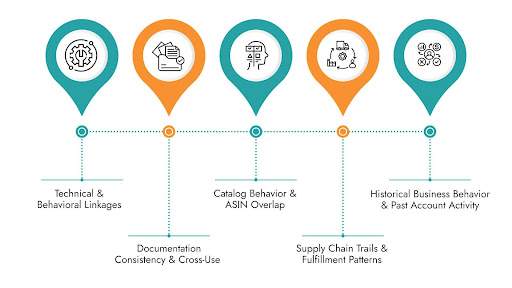
To understand how Amazon enforces its multiple-account policy, you have to look at how it evaluates connections behind the scenes. Here’s what Amazon reviews when assessing whether two accounts are legitimately independent:
- Technical & Behavioral Linkages
Amazon continuously collects data on account access, including IP addresses, Wi-Fi networks, device IDs, and browser details. If two accounts share login patterns, Amazon treats this as evidence of shared control, triggering a review even before any violations occur.
- Documentation Consistency & Cross-Use
Amazon also reviews document consistency across accounts. If business licenses, utility bills, or invoices show identical details, such as signatures, fonts, or supplier information, it may signal operational overlap. Even small details, such as matching invoice templates or repeated contact information, can raise red flags.
- Catalog Behavior & ASIN Overlap
Catalog activity is closely monitored. If two accounts sell the same branded ASINs, use the same suppliers, or upload similar listings, Amazon looks for a connection. This is particularly true if one account has a history of policy issues with specific products or suppliers.
- Supply Chain Trails & Fulfillment Patterns
Amazon examines the entire chain of sourcing, storage, and fulfillment for each seller account. Shared prep centers, identical packaging styles, overlapping carriers, or repeat supplier records can all signal that the same team runs accounts. Even if you’ve set up separate companies, Amazon expects each account to have clearly defined and independently documented supply chain workflows.
- Historical Business Behavior & Past Account Activity
Amazon also reviews patterns in pricing, brand strategy, performance history, and appeals activity. If a seller previously operated a suspended account and later opens a new one with similar catalog choices or business behaviors, Amazon may retroactively link the accounts. From Amazon’s perspective, reopening a new account to continue past activity can be seen as an attempt to circumvent suspension policies. Sellers must prove a clear separation between accounts to avoid suspension risk.
When Legal Support Becomes Necessary
Multi-account issues can escalate quickly, especially when Amazon’s systems interpret regular activity as shared control. Legal support becomes essential when the situation calls for precise, evidence-backed clarification.
You should involve an attorney when:
- The deactivation notice is vague or doesn’t explain what Amazon flagged.
- Your accounts were set up under older rules and don’t meet today’s standards.
- Shared suppliers, documents, or brand assets create confusion.
- Your appeals have been denied, and you’re losing reinstatement opportunities.
- Your business structure involves partners or licensing that needs clarification.
Legal guidance helps frame your operations clearly, close documentation gaps, and present a reinstatement case that aligns with Amazon’s internal review process.
Safeguard Multiple Amazon Seller Accounts With Expert Legal Support

Managing multiple Amazon seller accounts can help you scale faster, but it also puts you directly under Amazon’s strict compliance framework. Which is why you need a response that clearly explains why your multiple Amazon seller accounts are legitimate, compliant, and independently operated, supported by evidence that Amazon trusts.
At ESQGo, we help sellers navigate complex multi-account situations every day. We understand how Amazon detects linked accounts, how it interprets documentation, and what it considers a valid business need. Our legal team builds structured, evidence-based submissions that
Call or text 888-600-1925 or complete a Free Case Evaluation form