A suspended Walmart seller account can stop your entire business overnight. Orders freeze, listing privileges disappear, and every minute you stay suspended creates a widening gap between you and your competitors. What most sellers don’t realize is that Walmart suspensions rarely happen without warning; there’s almost always a clear operational or policy-related issue behind the decision.
Walmart monitors seller activity closely to protect customers and maintain marketplace trust. When certain red flags repeatedly appear across your listings, fulfillment process, product quality, or documentation, the platform steps in. Understanding these triggers is the best way to avoid suspension in the first place.
In this blog, we will explore the most common yet serious reasons Walmart suspends seller accounts, so you know exactly what puts your account at risk.
7 Reasons Your Walmart Account Can Be Suspended
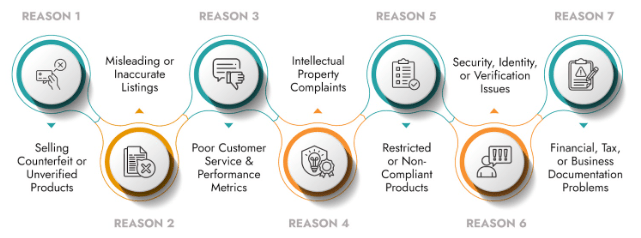
Here are a few reasons your Walmart account may get suspended:
Reason 1: Selling Counterfeit or Unverified Products
Selling products that Walmart cannot verify as authentic is one of the fastest ways to lose your seller privileges. Walmart takes product authenticity extremely seriously because counterfeit listings expose the platform to legal, brand, and customer trust issues. Even if you never intended to sell fake products, Walmart can still flag your account if something in your supply chain seems questionable.
Authenticity issues don’t always come from obvious knockoffs. More often, sellers are suspended for sourcing items from unauthorized distributors, purchasing liquidation or gray-market inventory, or listing branded items without proper documentation. Walmart wants proof that every item came from a legitimate, traceable supplier. If you can’t provide invoices, authorization letters, or clear supply chain records when requested, your account becomes an immediate risk.
Reason 2: Misleading or Inaccurate Listings
Walmart expects every listing to match precisely what the customer will receive. Even minor inconsistencies, like outdated images, missing product details, or unclear variations, can lead to complaints. If Walmart notices repeated inaccuracies that confuse buyers or misrepresent the product, the platform considers it a trust issue.
Common mistakes include using keywords that don’t match the item, placing products in the wrong category, exaggerating features, or reusing generic manufacturer descriptions, which can create confusion. These errors can lead to returns, negative reviews, and a pattern of customer dissatisfaction, which Walmart monitors closely.
Suppose your listings frequently trigger customer complaints or show signs of manipulation (such as using competitor brand names or creating misleading variations). In that case, Walmart may suspend your account to protect marketplace integrity. Keeping listings accurate, honest, and regularly updated is essential to avoid this type of suspension.
Reason 3: Poor Customer Service & Performance Metrics
Walmart’s marketplace is built on fast shipping, clear communication, and reliable customer experiences. When sellers repeatedly fall short, Walmart sees it as a sign they can’t maintain service standards, and suspension can follow, even with solid sales.
The biggest red flags include late shipments, slow response times, high return rates, and unresolved customer complaints. These metrics show how well you manage inventory, support buyers, and maintain operational consistency. When these numbers slip, the platform treats it as a signal that customers may not receive the experience Walmart promises.
The tricky part is that issues build quietly over time; a few slips may pass, but repeated patterns trigger Walmart’s systems. Once several metrics drop below thresholds, Walmart suspends accounts to protect customers from service.
Reason 4: Intellectual Property Complaints
Intellectual property (IP) complaints are among the most serious triggers of Walmart account suspensions. When a brand or rights holder reports that your listing uses their trademark, copyrighted content, or patented design without permission, Walmart is required to act quickly. These complaints create legal exposure for the platform, so even a single verified report can put your account at risk.
Most sellers assume IP issues only involve obvious counterfeits, but they can happen in far more subtle ways. Using a brand’s images without approval, referencing protected terms in your product description, listing items in restricted territories, or selling products from a supplier who doesn’t have brand authorization, all of these can lead to an IP violation. Even if the product itself is authentic, the way it’s presented or sourced may still raise compliance concerns.
Walmart doesn’t always investigate the legitimacy of the rights holder’s complaint first; they act conservatively to avoid liability. That means if your account receives multiple IP claims or you can’t provide the supporting documentation Walmart requests, suspension becomes likely. Protecting your account requires listing products you have full rights to sell and being careful with the content you use in each listing.
Reason 5: Restricted or Non-Compliant Products
Walmart has strict rules about what can and cannot be sold on the marketplace, especially in categories involving safety, regulations, or special certifications. If you offer restricted items or don’t provide required documentation, Walmart may suspend your account without warning.
Restricted categories often include children’s products that must meet CPSIA standards, certain electronics that require FCC approval, health and wellness items that need FDA compliance, and anything that poses safety or chemical risks. Many sellers get flagged simply because they didn’t realize extra testing, labeling, or certifications were required.
Walmart also removes and restricts high-risk products that are hard to verify, require special handling, or draw frequent complaints, and may suspend the entire account to prevent repeat issues.
Reason 6: Security, Identity, or Verification Issues
Walmart treats account security as a core part of marketplace safety. If anything in your profile suggests inaccurate information, unauthorized access, or mismatched business details, Walmart may suspend your account to prevent potential fraud or identity misuse.
This can happen for simple reasons, like outdated business documents, inconsistent tax information, or changes in ownership that weren’t updated in your seller profile. It can also happen if Walmart detects unusual login patterns, multiple accounts connected to the same information, or activity that suggests someone else may have accessed your account. Even something as small as mismatched names between your banking details and business registration can trigger a review.
Many sellers are surprised to learn that verification issues aren’t always tied to wrongdoing; they often result from administrative oversights. But from Walmart’s perspective, these inconsistencies raise questions about who actually controls the account and whether all business information is valid. To protect the marketplace, Walmart will suspend first and request clarification later.
Reason 7: Financial, Tax, or Business Documentation Problems
Walmart expects sellers to maintain accurate and up-to-date financial and tax records. If anything doesn’t match, your account can be suspended until you fix it. These checks support Walmart’s state and federal compliance, so they’re enforced strictly.
Typical triggers include missing tax forms, expired or invalid business registration, wrong bank details, or inconsistencies between your legal business name and the information on file. Sellers are also flagged for failing to update records after changes such as switching banks, adding partners, or restructuring. Even minor mismatches, such as an old address or an EIN that doesn’t align with your business name, can cause a suspension.
Walmart also monitors financial risk, such as recurring payment failures or unresolved billing issues. If the platform doubts your ability to handle refunds or payouts, it may restrict access.
To avoid this, treat your seller profile like a legal document: keep every detail consistent and update it immediately when something changes.
For a free legal consultation, call 888-600-1925
When You May Need Legal Assistance
Not every Walmart issue requires an attorney, but certain situations are complex enough that professional help can make the difference between reinstatement and long-term account loss.
You may need legal support when your suspension involves questions of
- Product authenticity,
- Repeated IP complaints,
- Restricted categories,
- Documentation gaps that Walmart won’t accept.
If notices cite multiple violations, appeals keep failing, or Walmart demands unclear supply-chain, authorization, regulatory, or identity proof, experienced legal guidance can fully protect your long-term marketplace access.
Safeguard Your Walmart Account With Expert Guidance
A Walmart suspension can halt your operations instantly, freezing listings, delaying payouts, and putting your entire business on hold. Sometimes the reasons behind your suspension may be vague, but the stakes are too high to rely on guesswork. You need a clear, structured approach that addresses Walmart’s compliance expectations.
At ESQGo, we work with Walmart sellers facing high-risk compliance issues every day. Our legal team understands how Walmart evaluates violations, which documentation it takes seriously, and how to position your case. With the proper guidance, you can resolve complex compliance problems and protect your long-term standing in the marketplace.
Your Walmart account is a significant part of your business. You shouldn’t navigate policy violations, brand complaints, or documentation disputes alone. When the consequences include lost revenue and long-term account restrictions, professional support makes all the difference.
Additionally, ESQGo can help you assess your compliance risks and develop a strategy built for results before compliance matters escalate.
Get legal support for your Walmart business today.
Call or text 888-600-1925 or complete a Free Case Evaluation form